
Updated Style Guide · Real Fashion for Your Daily Life
Trends Yes, Disguise No: The Key is Balance
Fashion changes every season, but your personal style should be the thread that connects everything. The problem arises when a trend is so viral that, if you copy it exactly, you risk feeling disguised, uncomfortable, or just “not you”.
In this article, I want you to be very clear about one thing: you can embrace trends without losing your essence. It’s about filtering, adapting, and balancing. Think of runways and Instagram as a showcase of ideas, not a manual that must be followed to the letter.
I will review the strongest current trends and, most importantly, how to bring them down to earth: to your body, your schedule, and your real wardrobe. Fashion is in my DNA, but so is practicality: I want you to know what to try, what to avoid, and how to make every look speak about you after reading this.
How to Detect if a Trend Suits You
Before adding anything to your wardrobe, take a second to pause. It’s not about impulse buying, but about validating whether that trend works with your life and style. You can use this mini mental test:
- Would you wear it more than 5 times? If you already know it will be “only for photos,” that’s a bad sign.
- Does it fit into your day-to-day life? Think about your work, transportation, and regular plans.
- Does it go well with what you already have? It should combine with at least 3 items in your wardrobe.
- Do you recognize yourself in the mirror? If you feel strange, forced, or disguised, it’s not for you as is.
If most answers are “yes,” go ahead. If you doubt, don’t discard the trend, but reconsider the format: perhaps instead of a full garment, you need it in the form of an accessory, color, or detail.

Base Wardrobe First, Trends Later
Without a good base, any trend becomes a disguise. You need a simple capsule wardrobe that works as a neutral canvas for everything else: garments that fit you well, in easy-to-combine colors, and with cuts that you already know flatter you.

The Base Pieces That Support (Almost) Any Trend
Here’s a minimal list to build on and add trends thoughtfully:
- Relaxed fit white or cream shirt.
- Straight or slightly wide jeans in medium blue.
- Trousers in a neutral tone (beige, gray, or black).
- Plain midi or short dress in your go-to color.
- Structured blazer that elevates any look.
- Lightweight sweater in nude, cream, or light gray.
- Clean and simple sneakers + neutral ankle boots.
With this covered, every trend comes in as an “invite”: a metallic skirt, a ruffled top, a cape coat… Everything is softened when the rest of the look is recognizable and very much yours.
Current Trends and How to Adapt Them to Your Style
Let’s get specific. I’ll go over several strong trends right now and tell you how to wear them without looking disguised. Always think of three levels of intensity: soft version, medium version, and “editorial” version (only if you feel comfortable).
1. Cream Tones and Total Light Looks
Total looks in cream, beige, or off-white are one of the most elegant bets of the season. They refine the silhouette, give a sense of order, and work for both the office and events.
The risk: ending up looking rigid, too “perfect,” or afraid of getting dirty. The key is to play with textures and cuts, not just with color.
As a stylist with international experience in major brands and fashion magazines points out, what transforms a look is not just the garment, but the criterion with which you mix volumes, fabrics, and proportions to fit with who you are and with your day-to-day.
- Start with one cream garment (pants or skirt) and mix with white and nude.
- Break the excess delicacy with a black or toasted brown shoe.
- Add a different texture: thick knit, linen, soft satin.

2. Baggy Pants and Relaxed Silhouette

Baggy pants are here to stay: comfortable, wide, and with that urban touch that looks great in street style. The problem is that if you don’t balance the rest well, you can feel “shapeless” or messy.
I see them perfect for giving a modern twist to your wardrobe if:
- You combine them with more fitted tops (body-hugging t-shirts, thin-strapped tops, tucked-in shirts).
- You add a structured shoe: mules, ankle boots, or clean sneakers.
- You define your waist with a thin belt or a slightly cropped top.
If you’ve been wearing skinny jeans for years, start with a soft baggy: medium rise, wide leg but not exaggerated, and a length that doesn’t drag.
3. Festival Boho… in Urban Mode
The festival boho style returns every spring: off-shoulder tops, flowy skirts, crochet, hats, cowboy boots. It’s fun at a festival; in day-to-day life, it can feel exaggerated.
Instead of copying the complete look, keep one boho gesture and blend it with urban basics.
- Soft option: lightweight kimono over straight jeans and a white t-shirt.
- Medium option: flowy long skirt with a band t-shirt and sneakers.
- Intense option: complete boho set, but with polished makeup and hair.

4. Kimonos and Statement Print Pieces
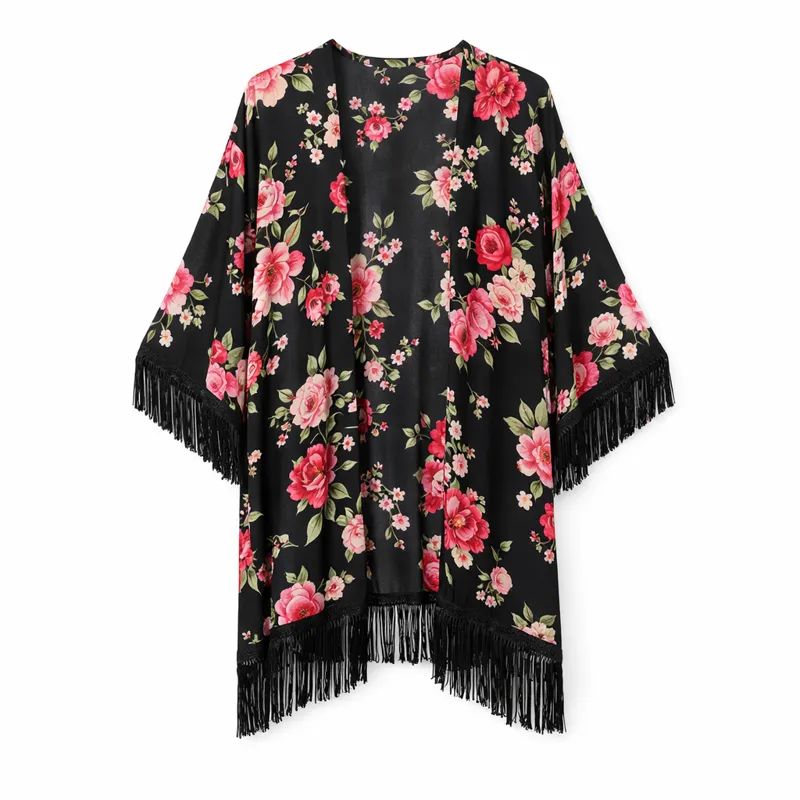
Printed kimonos are perfect for those who want to add color or print without complicating things. The trick is to make it clear that the kimono is the star and everything else is its “support team”.
To avoid feeling disguised, follow this rule: one standout piece per look. If the kimono already has flowers, strong colors, or shine, keep the rest in solid neutals.
5. Cape Coats and Blanket Coats
Caped coats and blanket coats add a sophisticated and different touch, but they can also make you feel “too much on a trend”. The key is to tame the volume.
- Wear them with clean pants: straight, soft skinny, or contained flare.
- Avoid mixing with huge garments underneath; better thin layers that don’t add more volume.
- Play with a single color contrast: gray cape with a beige/white base, for example.

6. Elegant Black Jumpsuit (the New LBD)

The black jumpsuit has become the new little black dress. It’s comfortable, versatile, and has that effortless sophisticated touch. The risk is that if the fit doesn’t match, you might feel trapped or “uniformed.”
To adapt it to your style:
- Choose a neckline that you usually wear (V, halter, strapless…).
- Play with footwear to set the code: fine sandals for events, ankle boots or loafers for daily use.
- Add your touch: special belt, large earrings, red lips, or relaxed updo.
Think of it as a black canvas ready to be “tuned” according to your plan and personality.
7. Shine, Metallics, and Editorial Looks
Metallics and shines have come out of the night and now live during the day too. Silver skirt with a wool sweater, shiny top with jeans… Everything works, as long as you feel like yourself within the look.
The easiest way to not look disguised is to use a single standout piece and tone down the rest to very simple basics.
- Metallic skirt + white t-shirt + black blazer.
- Silver top + straight jeans + minimal sandals.
- Small shiny bag with a totally neutral look.

Accessories That Update Without Disguising
If you don’t see yourself in certain trendy pieces, accessories are your best ally. They allow you to try new things without committing to the entire outfit and, if one day you don’t feel it, just leave them at home.
Statement Sunglasses

Sunglasses are a very quick style gesture: they change the mood of the look in seconds. If you usually go classic, try a slightly larger frame, in tortoiseshell or in a soft color (lavender, bottle green, burgundy…).
To avoid looking odd, follow these two rules:
- Ensure the base shape flatters you (soft cat-eye, round, square…).
- There should be a hint of color, but not an invasion (gradient lenses, colored arms, etc.).
Bags, Shoes, and Jewelry as a “Laboratory”
If you want to try a strong trend (like intense red, silver, or large florals) but don’t see yourself in a full dress, bring that trend to your accessories:
- Red bag with a total neutral look.
- Metallic shoe with jeans and a basic t-shirt.
- Large earrings with a low ponytail and a plain t-shirt.
Think of it as a laboratory: try, adjust, repeat what works for you and discard what doesn’t, without drama.
Trending, but Adapted: Hair and Makeup
Your hair and makeup are also part of the look, and often that’s where you can turn up or down the volume of a trend without touching your clothes.
In summer, for example, soft wave hairstyles and shiny finishes dominate the feed. If you don’t want to feel too produced, seek a middle ground:
- Less defined waves, more like “lived-in hair”.
- Products that care for the hair (protective sprays, lightweight serums) without stiffness.
- Simple updos with loose strands, very relaxed.
With makeup, think the same: if red lips seem “too much,” try a blurred raspberry lipstick. It’s the same idea, just scaled down to your territory.

How to Build Your Own Trend Filter
So you don’t rely on endless lists, I propose a small method to quickly and coherently filter trends with yourself.
Step 1: Define Your “Style Core”
Write three words that define how you like to dress most of the time. For example:
comfortable
feminine
minimal
boho
urban
romantic
Each time you see a trend, ask yourself if you can describe it with at least one of those words. If the answer is “no,” beware: you may only like to see it on others.
Step 2: Adjust the Volume
Imagine that each trend has a “volume” from 1 to 10. You decide how many decibels you want it in your life:
- Volume 3: appears in details (accessories, soft prints, one single color).
- Volume 6: is the protagonist of one garment, but in a balanced look.
- Volume 9-10: full look, almost editorial, reserved for when you’re willing to take risks.
Most of your daily looks will work well between 4 and 6. Save the extremes for moments when you feel like playing more.
Step 3: Test at Home Before Wearing Out
When you have a very trendy piece, do this little home test:
- Try at least 3 different combinations with things you already have.
- Walk, sit, look at yourself from different angles.
- Take a couple of mirror selfies (it helps more than it seems).
If after 10-15 minutes you still see yourself as strange, the problem likely isn’t you or the trend: that specific piece isn’t well integrated into your style.
Signs That You Are Disguised (and How to Fix It)
It’s not always easy to detect when a trend is leading you to a territory that doesn’t represent you. These signs are a clear warning:
- You change clothes as soon as you get home because you can’t stand the look.
- You spend the day adjusting garments, straps, necklines, hems…
- You feel very observed, even if no one is saying anything.
- You have trouble recognizing your silhouette or your way of moving.
If it happens, don’t panic. Make small adjustments:
- Reduce the contrast: replace one of the standout garments with a basic.
- Lower the volume: go from a total look to just a touch of trend.
- Wear your usual hairstyle and makeup to balance the novelty.
Your Style First, Always
Fashion is fun when it accompanies you, not when it directs you. I want trends to be tools at your service, not a to-do list. Remember:
- You don’t have to wear everything that’s in vogue.
- You’re not late if you adapt things slowly.
- What looks good on you one year doesn’t expire because the algorithm changes.
The question is not “Is this in fashion?”, but “Does it fit with me and my life?” If the answer is yes, go for it. If not, look at the trend, get inspired, and let it pass by without guilt.
Frequently Asked Questions About Trends and Personal Style
How do I know if a trend really suits me?
Look in the mirror and ask yourself if you recognize your silhouette and your way of moving. If the garment forces you to change your posture or gestures, it probably doesn’t suit you. Additionally, it should match with at least three garments you already have.
Is it a good idea to invest a lot of money in very trendy garments?
Only if they fit perfectly into your base style and you know you’ll wear them for several seasons. For fleeting trends, it is wiser to look for affordable versions or limit yourself to accessories, thus reducing the risk of getting tired quickly.
How do I adapt a trend if I work in a formal environment?
Bring the trend into colors, fabrics, or accessories instead of very flashy garments. For example, a metallic bag with a neutral suit, stylish sunglasses in a current shape, or a top with ruffles under a classic blazer.
Can I mix several trends in one look?
Yes, but it’s better to limit the spotlight to one and keep the others in the background. For example, baggy pants (the main trend) with flashy sunglasses and a colored bag, keeping the t-shirt and shoes very basic to avoid overload.
What should I do with trendy garments I no longer feel represent me?
Start by trying them with very neutral basics to give them a second life. If you still don’t see yourself, consider selling them, trading them, or donating them. There’s no sense in holding onto clothes that only remind you of impulse buys or trends that no longer fit with you.